
Monday, July 4, 2011

Equipping Horses
.
Although you can ride a horse bareback, it’s not a very practical way to travel, particularly if you need to carry anything with you. By the time Anne Arundel residents were traveling by horseback, equipping a horse entailed the services of an array of specialized craftsmen to produce the leather and metal articles that made for a comfortable trip.
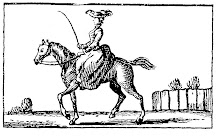
A variety of sources are available to tell us about the equipment needed for a horse more than two hundred years ago. Philip Vickers Fithian’s account [p.16] of his trip from New Jersey to Virginia in October 1773 provides a list of the minimum purchases required for a long-distance trip on a horse. Store accounts and inventories of both store goods and decedents’ horse-related possessions provide other documentation. Visual images – paintings, lithographs, etc. – offer another look at the well-dressed horse.

More Mondays ago than I care to remember, I explored a different avenue for studying equipment when I visited Jefferson Patterson Park and Museum to spend some time with Sara Rivers-Cofield, Curator of Federal Collections. Sara and I discovered a mutual interest in colonial horses last fall when we both attended a one-day symposium at Belair Mansion (which shall figure more importantly in later posts). We decided then that we should get together to share information as soon as we found a mutually convenient date.
Mostly Sara provided information and I took pictures and notes. Because the MAC lab is a repository for collections from around the state, Sara is in the enviable position of having enough pieces of stirrup iron, bosses from bridles, nails from saddles, and other fragments to begin to put together a picture of what horses were wearing over time. One or two tacks or bosses don’t tell a researcher much, but when you have twenty or thirty, you can begin to compare and draw conclusions.

That’s not what I’m going to do here, though. Instead, I’ll start with Fithian’s account and try to provide some visual accompaniments for his notations of what he bought for his journey. Fithian started with a horse, of course, and that may be the hardest purchase to illustrate correctly. No need to include a Stubbs painting as Fithian certainly didn’t buy a Thoroughbred. But he did pay £25 for the animal, so he probably bought a relatively young horse bred for stamina rather than speed, the kind of “genuine country horse” described by Ruffian’s owner in his 1793 advertisement.

Two days before he bought the horse, Fithian set about acquiring the leather goods needed for his trip. He noted first the purchase of a “Saddle, Bridle, Spurrs, etc.,” and the “etc.” must have also included reins. The same day he also bought a “Pr of Sadle-Bags.” The day after buying his uncle’s horse, Fithian “Had my Boots altered & mended – Was measured for a Surtout-Coat.” Travelers covering long distances had to be sure they too were well-equipped; sturdy boots and a warm, heavy overcoat were necessities in October.
Fithian’s last step was to have shoes put on the horse. In New Jersey, where he lived, it is possible that a farrier did this work, if there were enough local customers to support such a specialized trade. A farrier not only made horseshoes and then shoed horses but also trimmed and balanced hooves. In Anne Arundel and the rest of the Chesapeake region, these tasks were carried out by blacksmiths as part of a broad array of services. Even at the end of the colonial period, there was not enough density of settlement to cause any smith to limit his trade to farrier’s work. [A google search today, however, of ‘farrier maryland’ will turn up 74,000 hits.]

When the Reverend Hugh Jones described traveling on horseback in the late seventeenth century, he wrote that “Our soil is generally sandy, free from stone, which makes itt verry convenient for travelling. And we have noe occasion for shoeing our horses except in frosty weather.” This apparently was true, at least on the lower western shore, into the eighteenth century, for excavations at a 1715 stable, on the plantation of Richard Smith, Jr., found no horseshoes, despite the presence of other horse equipage artifacts. But Fithian was making a trip from New Jersey through Maryland to Virginia and his horse needed shoes. Judging from the assemblage of horseshoe fragments at the MAC lab, Fithian’s horse was not the only one, and of course the few surviving blacksmith’s accounts from the colonial period include shoeing horses among the charges found in customer’s records.
Thus equipped and prepared, Fithian was ready to begin his journey on 20 October 1773.
.
[The stable was located on the Smith St. Leonard Site, 18CV91. Members of the public can volunteer and help dig the site through the Park's public archaeology program.]
.
Although you can ride a horse bareback, it’s not a very practical way to travel, particularly if you need to carry anything with you. By the time Anne Arundel residents were traveling by horseback, equipping a horse entailed the services of an array of specialized craftsmen to produce the leather and metal articles that made for a comfortable trip.
A variety of sources are available to tell us about the equipment needed for a horse more than two hundred years ago. Philip Vickers Fithian’s account [p.16] of his trip from New Jersey to Virginia in October 1773 provides a list of the minimum purchases required for a long-distance trip on a horse. Store accounts and inventories of both store goods and decedents’ horse-related possessions provide other documentation. Visual images – paintings, lithographs, etc. – offer another look at the well-dressed horse.

More Mondays ago than I care to remember, I explored a different avenue for studying equipment when I visited Jefferson Patterson Park and Museum to spend some time with Sara Rivers-Cofield, Curator of Federal Collections. Sara and I discovered a mutual interest in colonial horses last fall when we both attended a one-day symposium at Belair Mansion (which shall figure more importantly in later posts). We decided then that we should get together to share information as soon as we found a mutually convenient date.
Mostly Sara provided information and I took pictures and notes. Because the MAC lab is a repository for collections from around the state, Sara is in the enviable position of having enough pieces of stirrup iron, bosses from bridles, nails from saddles, and other fragments to begin to put together a picture of what horses were wearing over time. One or two tacks or bosses don’t tell a researcher much, but when you have twenty or thirty, you can begin to compare and draw conclusions.

That’s not what I’m going to do here, though. Instead, I’ll start with Fithian’s account and try to provide some visual accompaniments for his notations of what he bought for his journey. Fithian started with a horse, of course, and that may be the hardest purchase to illustrate correctly. No need to include a Stubbs painting as Fithian certainly didn’t buy a Thoroughbred. But he did pay £25 for the animal, so he probably bought a relatively young horse bred for stamina rather than speed, the kind of “genuine country horse” described by Ruffian’s owner in his 1793 advertisement.

Two days before he bought the horse, Fithian set about acquiring the leather goods needed for his trip. He noted first the purchase of a “Saddle, Bridle, Spurrs, etc.,” and the “etc.” must have also included reins. The same day he also bought a “Pr of Sadle-Bags.” The day after buying his uncle’s horse, Fithian “Had my Boots altered & mended – Was measured for a Surtout-Coat.” Travelers covering long distances had to be sure they too were well-equipped; sturdy boots and a warm, heavy overcoat were necessities in October.
Fithian’s last step was to have shoes put on the horse. In New Jersey, where he lived, it is possible that a farrier did this work, if there were enough local customers to support such a specialized trade. A farrier not only made horseshoes and then shoed horses but also trimmed and balanced hooves. In Anne Arundel and the rest of the Chesapeake region, these tasks were carried out by blacksmiths as part of a broad array of services. Even at the end of the colonial period, there was not enough density of settlement to cause any smith to limit his trade to farrier’s work. [A google search today, however, of ‘farrier maryland’ will turn up 74,000 hits.]

When the Reverend Hugh Jones described traveling on horseback in the late seventeenth century, he wrote that “Our soil is generally sandy, free from stone, which makes itt verry convenient for travelling. And we have noe occasion for shoeing our horses except in frosty weather.” This apparently was true, at least on the lower western shore, into the eighteenth century, for excavations at a 1715 stable, on the plantation of Richard Smith, Jr., found no horseshoes, despite the presence of other horse equipage artifacts. But Fithian was making a trip from New Jersey through Maryland to Virginia and his horse needed shoes. Judging from the assemblage of horseshoe fragments at the MAC lab, Fithian’s horse was not the only one, and of course the few surviving blacksmith’s accounts from the colonial period include shoeing horses among the charges found in customer’s records.
Thus equipped and prepared, Fithian was ready to begin his journey on 20 October 1773.
.
[The stable was located on the Smith St. Leonard Site, 18CV91. Members of the public can volunteer and help dig the site through the Park's public archaeology program.]
.
Wednesday, January 19, 2011

Horses Racing
.
In one of Patricia Moyes’ mysteries featuring C.I.D. Inspector Henry Tibbett, the inspector and his wife go sailing with friends off the coast of East Anglia. As they are returning home at the end of their sail, Tibbett notices that there is another boat nearby sailing a parallel course. He also becomes aware that for the remainder of their time on the water, his host and hostess are making many more adjustments to the sails and their course than had been true earlier. When they are finally back at their starting point, ahead of the other boat, Tippett congratulates his host on winning the race. “Race? What race?” replies the other man. “We never race.”

What has this to do with horses in Anne Arundel? Just that, as two boats sailing near one another on similar courses are almost always testing relative speed and skill, so too horse owners, as far back as the prehistoric nomads of central Asia who first domesticated the horse, matched their animals against one another, often with a wager on the outcome. Informal races in Maryland date back to the mid-seventeenth century when there were enough horses in the colony for owners to begin competing in match races during gatherings for fairs, church, or court days. Or, as the author of a history of racing in France (p.1) put it, “Desultory horse-racing of course exists in all countries where there are horses to be ridden and men or boys (especially the latter) to ride them; and the commencement of such horse-racing dates, no doubt, from the earliest period at which the horses of those countries submit . . . to bear riders upon their backs.”
The first races in England may have been those organized by Roman soldiers stationed in Yorkshire about 200 A.D. The first recorded race meeting, however, is believed to have taken place in 1174 at a horse fair held at Smithfield, London during the reign of Henry II. The first trophy awarded to a winner is similarly believed to be a small wooden ball decorated with flowers presented in 1512 by the organizers of a Chester fair.
One of the world’s most famous races dates to a period between these two events. The Il Palio di Siena originated in the 14th century; today 10 horses compete in a circuit of the piazza di campo but originally the race began outside the city with the finish line in the campo. Unlike the English match races, the palio began as a multi-horse competition, with the horses racing for contrada, or Sienese neighborhoods, rather for than individual owners.

Despite the Smithfield and Chester races, today Newmarket is considered the home of horse racing in England. According to the Newmarket Racecourses website, in fact, “Newmarket is the historic Home of Horseracing and the greatest horseracing centre in the world.” (And, truthfully, for those of us who are Dick Francis fans, the idea of hanging out in Newmarket for a few weeks or months to soak up the ambience sounds like nirvana.) Legend has it that James 1 discovered the village in 1605 while out hawking or riding, and subsequently spent so much time there that the House of Commons requested that he spend a bit more of it on ruling the country. It was James who had the first grandstand built on Newmarket heath. From here spectators could watch the first recorded race, a match on 18 March 1622 between horses belonging to Lord Salisbury and the Marquis of Buckingham. The latter’s horse won the prize worth £100, an enormous sum for the average Briton but much less so for the aristocratic owner of the horse. Spring and autumn race meetings began in Newmarket about the time that Charles I succeeded to the throne (1625) and the first Gold Cup race was held in 1634.

Charles II, when restored to the throne of England in 1660, resumed the royal association with Newmarket. The course’s records include “Articles ordered by his Majestie to be observed by all persons that put in horses to run for the Plate, the new Round-heate at Newmarkett, set out the 16th day of October, in the 17th yeare of our Sovereaign Lord King Charles II. Which Plate is to be rid for yearly, the seconde Thursday in October, for ever.” There were twenty articles in all, which laid out the rules for a race consisting of three heats and “the course,” specifying the time, the weights to be carried, the behaviour expected of participants, the circular shape, and the stakes involved. The first race is dated to 1666, but this would require the articles to take effect in the 7th year of the monarch’s reign. As Charles is credited with winning the Plate in both 1671 and 1675 (“rode 3 heats and a course and won the Plate” on Blew Capp), it would seem that the 1666 date (the one used by Newmarket itself) is correct. These were the first races in England to be held according to written rules.

The year 1665, when the articles were drawn up, is the key to devoting some attention to Newmarket even though it too is not in Anne Arundel County. In that same year, Charles II directed Richard Nicolls, the governor of New York, to lay out a racecourse called Newmarket . The course was constructed on what was then known as Salisbury Plains on Long Island, now Hempstead Plains, near present-day Garden City and within a few miles of Belmont Park, home of the last leg of the Triple Crown. The Newmarket (LI) cup dates to 1668, making it the oldest trophy race in the British North American colonies.
It needs to be noted that the horses racing at Newmarket and elsewhere were not yet Thoroughbreds, but the breeding stock that contributed to the development of the Thoroughbred does date from Charles II and his marriage to Catherine of Braganza. Catherine, who married Charles in 1662, was the daughter of John IV of Portugal and as part of her dowry England acquired the ports of Bombay and Tangier. The “royal mares” imported from Tangier, known as Barbs, were later bred with imported middle-eastern and North African stallions to develop the Thoroughbred horse.
.
In one of Patricia Moyes’ mysteries featuring C.I.D. Inspector Henry Tibbett, the inspector and his wife go sailing with friends off the coast of East Anglia. As they are returning home at the end of their sail, Tibbett notices that there is another boat nearby sailing a parallel course. He also becomes aware that for the remainder of their time on the water, his host and hostess are making many more adjustments to the sails and their course than had been true earlier. When they are finally back at their starting point, ahead of the other boat, Tippett congratulates his host on winning the race. “Race? What race?” replies the other man. “We never race.”

What has this to do with horses in Anne Arundel? Just that, as two boats sailing near one another on similar courses are almost always testing relative speed and skill, so too horse owners, as far back as the prehistoric nomads of central Asia who first domesticated the horse, matched their animals against one another, often with a wager on the outcome. Informal races in Maryland date back to the mid-seventeenth century when there were enough horses in the colony for owners to begin competing in match races during gatherings for fairs, church, or court days. Or, as the author of a history of racing in France (p.1) put it, “Desultory horse-racing of course exists in all countries where there are horses to be ridden and men or boys (especially the latter) to ride them; and the commencement of such horse-racing dates, no doubt, from the earliest period at which the horses of those countries submit . . . to bear riders upon their backs.”
The first races in England may have been those organized by Roman soldiers stationed in Yorkshire about 200 A.D. The first recorded race meeting, however, is believed to have taken place in 1174 at a horse fair held at Smithfield, London during the reign of Henry II. The first trophy awarded to a winner is similarly believed to be a small wooden ball decorated with flowers presented in 1512 by the organizers of a Chester fair.
One of the world’s most famous races dates to a period between these two events. The Il Palio di Siena originated in the 14th century; today 10 horses compete in a circuit of the piazza di campo but originally the race began outside the city with the finish line in the campo. Unlike the English match races, the palio began as a multi-horse competition, with the horses racing for contrada, or Sienese neighborhoods, rather for than individual owners.

Despite the Smithfield and Chester races, today Newmarket is considered the home of horse racing in England. According to the Newmarket Racecourses website, in fact, “Newmarket is the historic Home of Horseracing and the greatest horseracing centre in the world.” (And, truthfully, for those of us who are Dick Francis fans, the idea of hanging out in Newmarket for a few weeks or months to soak up the ambience sounds like nirvana.) Legend has it that James 1 discovered the village in 1605 while out hawking or riding, and subsequently spent so much time there that the House of Commons requested that he spend a bit more of it on ruling the country. It was James who had the first grandstand built on Newmarket heath. From here spectators could watch the first recorded race, a match on 18 March 1622 between horses belonging to Lord Salisbury and the Marquis of Buckingham. The latter’s horse won the prize worth £100, an enormous sum for the average Briton but much less so for the aristocratic owner of the horse. Spring and autumn race meetings began in Newmarket about the time that Charles I succeeded to the throne (1625) and the first Gold Cup race was held in 1634.

Charles II, when restored to the throne of England in 1660, resumed the royal association with Newmarket. The course’s records include “Articles ordered by his Majestie to be observed by all persons that put in horses to run for the Plate, the new Round-heate at Newmarkett, set out the 16th day of October, in the 17th yeare of our Sovereaign Lord King Charles II. Which Plate is to be rid for yearly, the seconde Thursday in October, for ever.” There were twenty articles in all, which laid out the rules for a race consisting of three heats and “the course,” specifying the time, the weights to be carried, the behaviour expected of participants, the circular shape, and the stakes involved. The first race is dated to 1666, but this would require the articles to take effect in the 7th year of the monarch’s reign. As Charles is credited with winning the Plate in both 1671 and 1675 (“rode 3 heats and a course and won the Plate” on Blew Capp), it would seem that the 1666 date (the one used by Newmarket itself) is correct. These were the first races in England to be held according to written rules.

The year 1665, when the articles were drawn up, is the key to devoting some attention to Newmarket even though it too is not in Anne Arundel County. In that same year, Charles II directed Richard Nicolls, the governor of New York, to lay out a racecourse called Newmarket . The course was constructed on what was then known as Salisbury Plains on Long Island, now Hempstead Plains, near present-day Garden City and within a few miles of Belmont Park, home of the last leg of the Triple Crown. The Newmarket (LI) cup dates to 1668, making it the oldest trophy race in the British North American colonies.
It needs to be noted that the horses racing at Newmarket and elsewhere were not yet Thoroughbreds, but the breeding stock that contributed to the development of the Thoroughbred does date from Charles II and his marriage to Catherine of Braganza. Catherine, who married Charles in 1662, was the daughter of John IV of Portugal and as part of her dowry England acquired the ports of Bombay and Tangier. The “royal mares” imported from Tangier, known as Barbs, were later bred with imported middle-eastern and North African stallions to develop the Thoroughbred horse.
.
Thursday, January 13, 2011

From Scarcity to Nuisance
.
The Jamestown colonists found it necessary to slaughter their horses for food during the starving time of the first winter. We can assume, although without documentation as proof, that subsequent supply ships brought replacements for those horses, but it wouldn’t have been until the 1610s, after the initial years of famine had receded, that the colony’s supply of horses began to grow through births of foals in Virginia.
The accounts of the arrival of the Ark and the Dove, carrying the first Maryland settlers in 1634, are similarly silent on the subject of horses, although early ships must have carried a few even if there were none on the first voyage to Maryland. By the late 1640s, there were definitely at least seven horses in the colony for they turn up several times in the Provincial Court records (vol. 4 of the Archives of Maryland Online). These horses were the property of Leonard Calvert, brother of Lord Baltimore and governor of Maryland. Tracing them through the records, it appears that five of the horses -- three mares, a "stone horse" (stallion) and a colt -- were originally the property of Lord Baltimore, then were acquired by John Lewger, secretary of the colony, and sold by him in 1644 to Calvert in exchange for Calvert's payment of £100 sterling to John Smith, a linen draper (cloth merchant) in London, on Lewger's behalf.
The mid-1640s were a turbulent time for the Maryland colony, when Richard Ingle, a ship captain who supported the Parliamentary cause attacked the colony and for a time took over its government -- a period later referred to as the "plundering time." Leonard Calvert and others defended proprietary interests for some months but eventually fled to Virginia. There Calvert recruited soldiers and returned with a force of both Virginians and Marylanders to retake control of the colony. He evidently took at least a few horses with him when he crossed the Potomac into Virginia. In June of 1647, Virginia's governor, William Berkeley, wrote to say that he was sending back to Calvert a mare and colt in the care of a Mr. Trussel. Calvert also received a claim from Edward Hill, who was acting as governor for a time after Ingle's departure, for "satisfaction for Colclough’s horse, offered me in exchange of your filly at Chicacoan."
Leonard Calvert died unexpectedly on 11 June 1647. On his deathbed he named Thomas Greene as governor and Margaret Brent as his executor. Legacies included a "mare colt" to his godson Leonard Greene and the next "mare colt" born to Mrs. Temperance Pippett of Virginia. The inventory of Calvert's estate, appraised on the 30th of June, listed "3 Stone-horses 3 mares, & one Ston-colt" valued at 8400 pounds of tobacco and a saddle and bridle worth 100 pounds. There is no further mention of horses until February 1649, when Margaret Brent sold one gray stone horse to Barnaby Jackson, a tailor, for 1700 pounds of tobacco. The bill of sale does not indicate that Brent acted as Calvert's exectuor, so it is possible that she sold one of her own horses.
The final reference to the governor's horses comes in 1650, when Thomas Thornborough submitted a petition to the court, asking that it enforce a commitment made by the deceased governor, Leonard Calvert, to give Thornborough a horse as compensation for his service at St. Inigoe’s fort. The horse in question was being held by Cuthbert Fenwick, who had bought it from Margaret Brent, Calvert’s executrix, who had sold it out of Calvert’s estate. When Jane Fenwick, Cuthbert's widow, died in 1661, the inventory of her estate included one horse, but there is no way to know whether or not it was the horse Thornborough claimed as his.

From the above evidence, or lack thereof, we could reasonably conclude that there were not many horses in the province through the 1650s. But other documents suggest that might not have been the case. By 1659, the Maryland legislature was enacting a law requiring “That all fences for Corne fields within this Province shall be five foote in height round the said field sufficient and strongly made in the Judgemt of two Indifferent men viewing the same in case of trespass[,] And in case any horse or horses or other cattle[1] shall happen to leape over such fence as aforesaid or breake it downe it being sufficient and strongly made as aforesaid That then the Owners of such horse or horses or other Cattle shall be lyable to pay the trespass[,] And in case the said Fence be not soe high that then the Owner or owners of such Corne feilds shall beare their owne losse comitted by the horse[,] horses or Cattle as aforesaid.” In other words, all corn fields had to enclosed by strong fences at least 5’ in height. If any horse managed to get into the field despite the fence the animal's owner had to pay damages, but if the fencing was inadequate, then the planter suffered the loss. Apparently there were enough horses on the loose by the late 1650s to be a threat to fields of corn.

Five years later, the legislative records indicate another recognition of the importance of horses for travel within the colony. An Act for Ferrys stipulated that ferries over the St. George’s River in St. Mary’s County and the Wicomoco River in Charles County must have boats with a 14’ keel to carry “any person traveling on foot” but that an 18’ boat was required to provide for “men and horses[,] for the passinge or conveyinge over [the Patuxent River] all passengers whatsoever wth their horses travelinge either on foote or on horse back.”
The first law attempting to limit the importation of horses was passed in 1671. By the early 1680s, the legislature was considering several measures to control the number of horses in the colony, including not only limitations on importation, but also prohibition of ownership by non-landowners and a ban on stallions running loose that were not at least fourteen hands high to prevent any deterioration of the colony’s stock of horses. The general aim was “to lessen the Number of them that now are grown a Common Nusance.” This was to some degree a measure of social control – with the upper house arguing in favor of legislation to restrict ownership by the lesser sort while the lower house raised objections to the proposals. In the October 1683 session, the lower house did respond to a request for a proposal when “Mr Clement Hill and Mr Hutchins from the Lower house [came in] with a Bill for Lessening the Number of Horses” but after the first reading there is no further mention of the act.
In 1694, the assembly, distressed that earlier laws had not been effective, passed “An Act to prevent the greate Evill occasioned by the multiplicity of horses within this Province.” The law argued that “the small stature of Stallions running wild doth both Lessen & spoyle the whole breed and Streyne of all horses” but then noted “that which is most grievious and intollerable is the utter Ruine & destruccon of Corne Feilds, Pastures, and other Inclosures, which otherwise would produce great store of good & usefull provisions.” The remedy was a requirement that “yearly & every year all Owners of any horse horses Mares Colts and Geldings shall & are hereby obliged to keep all or any such Horse or Horses Mares Colts and Geldings withingood and sufficient Inclosures fenced grounds or pastures from the first day of May till the tenth day of November yearly for prevention of the greate Mischeife and Evills aforesaid.” The proliferation of wild horses had become enough of a problem to reverse the usual practice of letting animals roam freely while fields had to be fenced to keep them out. Horses now had to be enclosed in fenced pastures to protect crops from damage.

2 May 1754
Similar laws remained in effect for much of the colonial period but failed to remedy the problem. Issues of the Maryland Gazette in the 1750s and 1760s often have as many or more notices asking owners to collect lost or strayed horses as there are advertisements seeking the return of runaway servants and slaves.
.
[1] The OED defines ‘cattle,’ in the language of the stable, as applying to horses, in the way it is used in Georgette Heyer novels by aristocrats referring to the matched pairs they purchased for their carriages. As the likelihood of a cow or bull leaping over a colonial fence seems remote, this is perhaps also the legislative use of the word.
The Jamestown colonists found it necessary to slaughter their horses for food during the starving time of the first winter. We can assume, although without documentation as proof, that subsequent supply ships brought replacements for those horses, but it wouldn’t have been until the 1610s, after the initial years of famine had receded, that the colony’s supply of horses began to grow through births of foals in Virginia.
The accounts of the arrival of the Ark and the Dove, carrying the first Maryland settlers in 1634, are similarly silent on the subject of horses, although early ships must have carried a few even if there were none on the first voyage to Maryland. By the late 1640s, there were definitely at least seven horses in the colony for they turn up several times in the Provincial Court records (vol. 4 of the Archives of Maryland Online). These horses were the property of Leonard Calvert, brother of Lord Baltimore and governor of Maryland. Tracing them through the records, it appears that five of the horses -- three mares, a "stone horse" (stallion) and a colt -- were originally the property of Lord Baltimore, then were acquired by John Lewger, secretary of the colony, and sold by him in 1644 to Calvert in exchange for Calvert's payment of £100 sterling to John Smith, a linen draper (cloth merchant) in London, on Lewger's behalf.
The mid-1640s were a turbulent time for the Maryland colony, when Richard Ingle, a ship captain who supported the Parliamentary cause attacked the colony and for a time took over its government -- a period later referred to as the "plundering time." Leonard Calvert and others defended proprietary interests for some months but eventually fled to Virginia. There Calvert recruited soldiers and returned with a force of both Virginians and Marylanders to retake control of the colony. He evidently took at least a few horses with him when he crossed the Potomac into Virginia. In June of 1647, Virginia's governor, William Berkeley, wrote to say that he was sending back to Calvert a mare and colt in the care of a Mr. Trussel. Calvert also received a claim from Edward Hill, who was acting as governor for a time after Ingle's departure, for "satisfaction for Colclough’s horse, offered me in exchange of your filly at Chicacoan."
Leonard Calvert died unexpectedly on 11 June 1647. On his deathbed he named Thomas Greene as governor and Margaret Brent as his executor. Legacies included a "mare colt" to his godson Leonard Greene and the next "mare colt" born to Mrs. Temperance Pippett of Virginia. The inventory of Calvert's estate, appraised on the 30th of June, listed "3 Stone-horses 3 mares, & one Ston-colt" valued at 8400 pounds of tobacco and a saddle and bridle worth 100 pounds. There is no further mention of horses until February 1649, when Margaret Brent sold one gray stone horse to Barnaby Jackson, a tailor, for 1700 pounds of tobacco. The bill of sale does not indicate that Brent acted as Calvert's exectuor, so it is possible that she sold one of her own horses.
The final reference to the governor's horses comes in 1650, when Thomas Thornborough submitted a petition to the court, asking that it enforce a commitment made by the deceased governor, Leonard Calvert, to give Thornborough a horse as compensation for his service at St. Inigoe’s fort. The horse in question was being held by Cuthbert Fenwick, who had bought it from Margaret Brent, Calvert’s executrix, who had sold it out of Calvert’s estate. When Jane Fenwick, Cuthbert's widow, died in 1661, the inventory of her estate included one horse, but there is no way to know whether or not it was the horse Thornborough claimed as his.

From the above evidence, or lack thereof, we could reasonably conclude that there were not many horses in the province through the 1650s. But other documents suggest that might not have been the case. By 1659, the Maryland legislature was enacting a law requiring “That all fences for Corne fields within this Province shall be five foote in height round the said field sufficient and strongly made in the Judgemt of two Indifferent men viewing the same in case of trespass[,] And in case any horse or horses or other cattle[1] shall happen to leape over such fence as aforesaid or breake it downe it being sufficient and strongly made as aforesaid That then the Owners of such horse or horses or other Cattle shall be lyable to pay the trespass[,] And in case the said Fence be not soe high that then the Owner or owners of such Corne feilds shall beare their owne losse comitted by the horse[,] horses or Cattle as aforesaid.” In other words, all corn fields had to enclosed by strong fences at least 5’ in height. If any horse managed to get into the field despite the fence the animal's owner had to pay damages, but if the fencing was inadequate, then the planter suffered the loss. Apparently there were enough horses on the loose by the late 1650s to be a threat to fields of corn.

Five years later, the legislative records indicate another recognition of the importance of horses for travel within the colony. An Act for Ferrys stipulated that ferries over the St. George’s River in St. Mary’s County and the Wicomoco River in Charles County must have boats with a 14’ keel to carry “any person traveling on foot” but that an 18’ boat was required to provide for “men and horses[,] for the passinge or conveyinge over [the Patuxent River] all passengers whatsoever wth their horses travelinge either on foote or on horse back.”
The first law attempting to limit the importation of horses was passed in 1671. By the early 1680s, the legislature was considering several measures to control the number of horses in the colony, including not only limitations on importation, but also prohibition of ownership by non-landowners and a ban on stallions running loose that were not at least fourteen hands high to prevent any deterioration of the colony’s stock of horses. The general aim was “to lessen the Number of them that now are grown a Common Nusance.” This was to some degree a measure of social control – with the upper house arguing in favor of legislation to restrict ownership by the lesser sort while the lower house raised objections to the proposals. In the October 1683 session, the lower house did respond to a request for a proposal when “Mr Clement Hill and Mr Hutchins from the Lower house [came in] with a Bill for Lessening the Number of Horses” but after the first reading there is no further mention of the act.
In 1694, the assembly, distressed that earlier laws had not been effective, passed “An Act to prevent the greate Evill occasioned by the multiplicity of horses within this Province.” The law argued that “the small stature of Stallions running wild doth both Lessen & spoyle the whole breed and Streyne of all horses” but then noted “that which is most grievious and intollerable is the utter Ruine & destruccon of Corne Feilds, Pastures, and other Inclosures, which otherwise would produce great store of good & usefull provisions.” The remedy was a requirement that “yearly & every year all Owners of any horse horses Mares Colts and Geldings shall & are hereby obliged to keep all or any such Horse or Horses Mares Colts and Geldings withingood and sufficient Inclosures fenced grounds or pastures from the first day of May till the tenth day of November yearly for prevention of the greate Mischeife and Evills aforesaid.” The proliferation of wild horses had become enough of a problem to reverse the usual practice of letting animals roam freely while fields had to be fenced to keep them out. Horses now had to be enclosed in fenced pastures to protect crops from damage.

Similar laws remained in effect for much of the colonial period but failed to remedy the problem. Issues of the Maryland Gazette in the 1750s and 1760s often have as many or more notices asking owners to collect lost or strayed horses as there are advertisements seeking the return of runaway servants and slaves.
.
[1] The OED defines ‘cattle,’ in the language of the stable, as applying to horses, in the way it is used in Georgette Heyer novels by aristocrats referring to the matched pairs they purchased for their carriages. As the likelihood of a cow or bull leaping over a colonial fence seems remote, this is perhaps also the legislative use of the word.
Wednesday, January 5, 2011

Subscribe to:
Posts (Atom)